Avoid These 5 Common Mistakes When Selling Your Dubai Property

Written by
Driven | Forbes Global Properties
Updated: Sep 23, 2026, 10:31 AM

Driven | Forbes Global Properties
So, you found a buyer for your property at a good price. Congratulations! That means all your troubles are over, and you should get the cash over the next few days, right? Well, not exactly.
The selling process is not as simple as it may seem on the surface. You may be surprised to learn that handing over your house to a buyer can take up to three months, depending on the circumstances.
In Dubai, real estate agencies use the term ‘conveyancing’ to describe this handover process, which includes documentation, government approvals, and the fees involved in transferring property ownership.
In this article, we'll go over five common mistakes when selling property in Dubai that sellers often make during the conveyancing process and how to avoid selling property in Dubai mistakes.
Get a clear picture of what your property is worth in today's market before you list it. The Dubai Land Department publishes real transaction data you can check, or ask a RERA-registered agent for a comparison based on recent sales in your area. Pricing that is too high is probably the most common reason properties sit unsold for months.
Your agent must be RERA-registered, that's the baseline. Beyond that, check whether the brokerage has an in-house conveyancing team. Agencies that handle conveyancing internally tend to move faster because everything stays under one roof. No waiting for external parties.
The agent lists the property on platforms like Property Finder or Bayut, manages viewings, and brings offers to the table. Once buyer and seller agree on a price, you proceed with the contract.
Contract F is the legally recognized sale agreement in Dubai, accepted by the DLD, trustee offices, and courts. Both parties sign it digitally. You may hear agents mention an MOU (Memorandum of Understanding), which is an older format. Some developers still use it for NOC purposes, but most entities will ask for Contract F anyway. Better to start there.
The buyer pays a 10% deposit at signing, held until the transfer completes.
The No Objection Certificate comes from the developer, EMAAR, Damac, Nakheel, whoever built the property. It confirms there are no unpaid service charges or outstanding dues. Without it, the transfer cannot be done.
Timeline varies by developer. Some issues the NOC will address within three to five days. Others take closer to two weeks. Any unpaid service charges must be settled before the developer will even start the process.
With the NOC in hand, both buyer and seller go to a trustee office, a DLD-authorized center that handles the transfer officially. Documents are reviewed, submitted to the DLD, and ownership changes hands. If either party has a mortgage, the banks are coordinating here too: the buyer's loan is released, any existing mortgage on the seller's side is discharged, and the title deed is reissued in the buyer's name.
Payment is made at the trustee's office, almost always by the manager's check. The seller must be there in person or have arranged representation through a power of attorney beforehand. Once payment is collected and the transfer is confirmed, the buyer receives the new title deed by email.
Have these ready before the process starts. Waiting until someone asks for them adds delays that nobody wants.
If someone else is representing you at the trustee office, add a notarised Power of Attorney to this list.
This is the situation that catches sellers completely off guard. The UAE Golden Visa isn't just tied to an investment threshold; it's linked to a specific property. Sell that property without addressing the visa first, and it gets cancelled automatically at the point of transfer.
The moment ownership transfers to the buyer, the Golden Visa attached to that property becomes invalid. Sellers who find out after handover face residency complications and potential fines, which early communication could have entirely avoided.
There's also an immediate practical issue: if the DLD shows the property as "blocked," the sale can't proceed until that's resolved. A blocked status can mean several things: unpaid service charges, an open legal matter, or a Golden Visa link. The DLD won't tell you which one. Confirming a Golden Visa link requires a separate inquiry with the visa authorities directly.
If you own other UAE property worth at least AED 2 million, the Golden Visa can be transferred to that asset instead of being cancelled. This has to be initiated before the sale completes, not during or after.
For sellers with multiple properties who aren't sure which one the visa is tied to, they must contact the visa authorities directly to identify it. That alone can add one to two days to the handover timeline, and sometimes more.
A conveyancer can handle the legwork, but only with a Power of Attorney from the visa holder. Once the linked property is confirmed, the seller decides whether to cancel the visa or transfer it to another qualifying asset.
Tell your agent about the Golden Visa on day one. Do not wait until the buyer is found on day one.
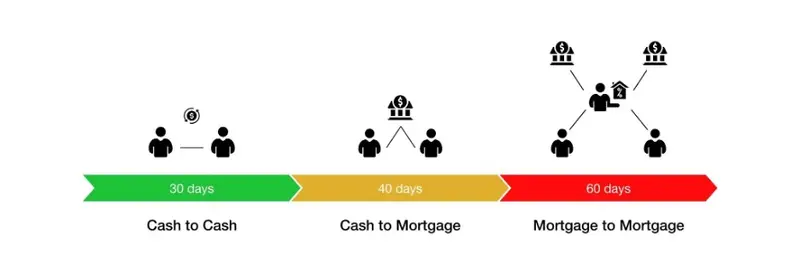
The timeline depends mainly on how the deal is financed.
Transaction Type | Typical Timeline |
Cash to Cash | 30 days |
Cash + Mortgage (either side) | 40 days |
Mortgage + Mortgage | 60 days |
Cash-to-cash is the fastest because no banks are involved on either side. Mortgage-to-mortgage is the most drawn-out, with two lenders, two approval chains, and any delay from either bank affecting the whole timeline.
One thing that often gets overlooked: when you submit the documents, it matters almost as much as what you submit. The DLD closes at 3 PM, Monday to Friday. Trustee offices stay open until 8 PM seven days a week, which gives sellers a false sense of flexibility. Documents submitted on a Thursday afternoon usually don't get DLD attention until Monday. That's nearly four days lost, even though no one has done anything wrong. Submit between Monday and Wednesday, where possible.
The 10-year Golden Visa is the most sought-after visa in the UAE, and foreign real estate investors can get one by spending at least AED 2 million on property in the country. Despite the significant benefit property owners receive from obtaining a Golden Visa, there are some Dubai conveyancing mistakes and unexpected complications that can occur when these visa holders sell their UAE property.
These Dubai real estate selling errors and complications occur when property owners forget that selling a Golden Visa-linked property will have an impact on their visa status. Doing so would be a critical oversight. Selling Dubai property legal issues includes selling a property linked to a Golden Visa necessitates the cancellation of that visa because of its direct link to that property, which can surprise an unsuspecting seller and lead to significant inconvenience, related fines, or other challenges.
Furthermore, if you own multiple UAE properties and aren’t 100% certain which one links to your Golden Visa, you will likely face a one to two day handover process delay. This is because of the extra steps you will need to take to identify a golden visa-linked property and resolve any issues that arises.
Determining which properties are associated with a Golden Visa can be difficult, especially for those who own multiple properties in Dubai. The first step is to check with the Dubai Land Department (DLD) if your property is “blocked” for sale, as this may signify a Golden Visa link.
However, checking the DLD alone cannot provide certainty. This is because while the DLD will show if a property is blocked for sale, they will not specify the reason. A “blocked” status can indicate unpaid service charges, an ongoing legal case, or a Golden Visa link. As a second steps, sellers must directly inquire with the visa authorities in Dubai to identify which property is associated with the Golden Visa. Conveyancers at your brokerage can assist in this process, but only with the visa holder's authorization through a Power of Attorney (POA). Once identified, the seller has the option to either transfer the Golden Visa to another property they own or cancel it.
So, if you are a Golden Visa holder looking to sell your property, it is important to alert your broker that you have a Golden Visa from the outset. Then, ensure that they take the necessary precautions and checks to avoid potential complications and delays during your property transaction.
When it comes to property transfers in Dubai, there are three important entities. These are the Dubai Land Department, trustee offices, and banks. The duties and office timings of these entities are as follows:
The Dubai Land Department (DLD)
The Dubai Land Department is the central governmental authority overseeing all real estate transactions and regulations in Dubai. It is the final authority on all property-related approvals, determining the legality and validity of real estate transactions.
Trustee Offices
Trustee Offices are officially designated by the DLD to serve as crucial intermediaries in property transactions. They act as authorized representatives of the DLD, streamlining the submissions process and ensuring compliance with regulations. Their function is administrative only. They do not oversee governance, nor do they make final decisions on property transfer approvals.
Banks
In Dubai conveyancing banks play a crucial role, particularly in financed property transactions. They are not merely document providers, but integral to the legal and financial process. Their involvement includes mortgage registration, no objection certificates (NOCs), loan disbursement, and more.
A common oversight when selling property in Dubai is failing to account for the varied operating hours of trustee offices, the Dubai Land Department (DLD), and, in some cases, the banks. These differences in operating hours can create property selling issues in Dubai and increase potential challenges for sellers, particularly when time-sensitive transactions are involved.
A seller, Ahmed, needs DLD approval for a property transfer. He plans to submit all documents to the Trustee Office on a Thursday afternoon, assuming the Trustee's extended hours will accommodate him. He knows he needs a Mortgage Redemption Letter from his bank to clear his existing mortgage.
Because of the delay, Ahmed's property transfer is pushed back, potentially affecting travel plans or financial commitments. Furthermore, if the buyer has a time-sensitive loan approval or other deadline, the delay could him or her to withdraw from the purchase. This is a significant risk for Ahmed.
If Ahmed had known about the bank's processing time and the DLD's limited Friday hours, he could have initiated the bank request earlier in the week. The fact that the trustee office is open weekends, does not mean the DLD is. This is a common point of confusion.
As a general rule, to avoid mistakes in Dubai property sales, sellers should submit conveyancing documents as early as possible. Ideally, between Monday to Wednesday to account for unexpected delays. Submitting documents on Thursday or Friday can put you at risk of weekend delays.
So, when working with different entities, keep in mind the difference in operating hours to ensure a smooth property transaction process.
In Dubai real estate transactions, you may encounter either a Memorandum of Understanding (MOU) or a Contract F. There are a few key differences between the two and reasons why using a Contract F is more advisable.
Using an MOU will not derail your sale by any means but it will add extra steps to your conveyancing because most key entities will ask for you to draft a Contract F. So, to ensure a smoother process, it’s advisable to use a Contract F from the start.
Service charges are a component of the buyer-seller financial settlement and relate to property service charges. A service charge often covers things like building common area maintenance, payments, and salaries. It is a separate cost from conveyancing and agency fees.
Sellers commonly pay service charges in advance, either quarterly or annually, when a property is sold. Therefore, if a seller has paid for a period that exceeds the property's transfer date, he is entitled to a refund for the unused portion.
Because sellers often misunderstand how service charge refunds work, they frequently expect to receive the entire fee back after a property is transferred to a buyer. In reality, the seller will only receive a prorated refund based on the number of unused days left in the contract period when the property is handed over to the buyer.
For example, Saqib is selling his property and has paid a quarterly service charge in advance (90 days).
This refund is usually resolved directly between the buyer and seller, rather than through a government organization or agency.
Going into a sale knowing how these refunds work will prepare you for the financial reality of service charges, and may save you an unpleasant surprise at handover.
One of the perks of living in Dubai, a global travel hub, is easy access to some of the best travel destinations in the world via international carriers such as Emirates and Etihad. And Dubai residents are known to regularly make use of this benefit.
As a seller, don’t overlook the importance of being physically present during the closing process, especially for “cash to cash” transactions, which have exceptionally tight timelines. Ignoring this may put the final sale of your property in jeopardy. Let’s look at the three payment types in real estate sales that impact the timeline.
Selling a property in Dubai is not only about the final sale price. Sellers also need to account for agency commission, Dubai Land Department transfer fees, NOC charges, mortgage settlement costs, service charge clearance, and possible maintenance or staging expenses before listing. These costs can affect the final amount you receive, so it is better to plan them early and price the property with a realistic margin.
Typically, 2% of the sale price. On an AED 2 million property, that's AED 40,000. The rate is fairly standard across the market.
Anywhere from AED 2,500 to AED 10,000, depending on the provider and complexity of the transaction. Mortgage-involved deals cost more to manage. Some brokerages include conveyancing in their overall service; others bill it separately. Ask before committing.
Set by the developer, so the number varies. Could be AED 500, could be closer to AED 5,000. Ask your agent early so it doesn't catch you off guard mid-transaction.
Selling a mortgaged property means paying an early settlement fee to your bank, usually around 1% of the outstanding balance, sometimes capped. Check your original mortgage agreement. Sellers regularly forget this cost until it's too late to plan around it.
AED 4,200 for properties above AED 500,000 and AED 2,100 for those below. The DLD transfer fee of 4% of the sale price is typically the buyer's responsibility, though parties occasionally negotiate on this.
Real estate transactions can generally be categorized into three main types, each with its own associated timeframe.
Some time frames are calculated in calendar days (including weekends), while others are calculated in business days (excluding weekends and holidays). Miscommunication regarding these differing timeframes can lead to delays and frustration.
The transaction types are as follows:
As a seller, you must be physically present during the final approval process for all types of transactions, whether cash or mortgaged. This is to make sure that all legal obligations are fulfilled and, above all, that you are personally collecting the check that is owed to you. This final approval process can range from as short as 15 minutes to 2-3 hours at a government trustee office.
Alternatively, you may arrange for someone else to collect the payments on your behalf. One method is having a third-party present your Emirates ID and a copy of the buyer's check that has been forwarded to the DLD with your signature on it. Another method is through a Power of Attorney (POA).
Buyers, on the other hand, are only required to be present for a short period of time. They usually only need to spend 15 to 60 minutes to sign paperwork and pay costs. Following that, buyers are free to depart as they will receive their title deed via email.
If you decide to travel and wish to make sure to avoid real estate transaction mistakes, make certain to alert your agent and conveyancing team, and be sure to be physically present for the final approval process. Doing so will help your real estate team build a closing timeline around your plans (and that of the buyer), so that the handover goes smoothly.
Conveyancing is the legal and administrative process of transferring property ownership from one person to another. In Dubai, it covers more than just paperwork; NOC collection, document preparation, bank coordination, trustee office submissions, and DLD approval all fall under it.
Conveyancers manage the administrative side of the transaction so buyers and sellers don't have to chase fifteen things at once. They liaise with developers for the NOC, coordinate mortgage clearance with banks, handle submissions to the trustee office, and keep the timeline moving. The better ones have established relationships with trustee offices that genuinely speed things up. Less experienced conveyancers can turn a 30-day transaction into a 50-day one through poor sequencing alone.
Emirates ID, passport copy, title deed, Contract F, NOC from the developer, and mortgage-related documents, where applicable. Full breakdown below.
Conveyancing runs alongside the overall transaction rather than as a separate phase. NOC processing and document collection tend to take the longest before the trustee office appointment can be scheduled.
AED 2,500 to AED 10,000. Confirm whether this fee is included in the agency's service or billed on top before signing anything.
DLD-authorized offices where the physical transfer takes place. Open seven days a week, 8 AM to 8 PM. But as mentioned, the DLD closes at 3 PM on weekdays and doesn't operate on weekends. Thursday evening submissions at a trustee's office don't go anywhere until Monday. It's a common point of confusion that costs sellers days they can't get back.
The Dubai Land Department approves every property transfer in Dubai. It updates the ownership record and issues the new title deed. Operating hours: Monday to Friday, 8 AM to 3 PM.
The top brokerages have not only expert agents, but also expert conveyance teams. Since a conveyance team’s job is to successfully navigate around the Dubai property sale pitfalls above--bringing the sale of a property to a happy close--it’s important to enlist the right real estate brokerage or agency.
Here are some questions to ask when researching which conveyancing team or agency to use.
1. Does the conveyancing team or agency have a valid license to operate in Dubai?
First and foremost, ensure the conveyancing team is licensed to operate in Dubai. This verification is non-negotiable, whether you’re working with an in-house team from a real estate agency or an independent company.
2. Does the conveyancing fee, if any, match your budget?
Compare conveyancing fees from your selection of teams or agencies. Ensure that their fees match your budget to avoid accruing unexpectedly high fees. This is an important note as the range of conveyancing fees in Dubai can range from as low as AED 2,500 to as high as AED 10,000.
3. What is their reputation?
Look for a conveyancing team or agency with a strong reputation in the industry. Client reviews and word-of-mouth recommendations can provide valuable insights into their performance. Established real estate companies with in-house conveyancing departments often have extensive experience and established processes.
4. How fast is their service?
It’s worth asking your agent how many days it takes the brokerage’s conveyancing team to finalize the process given a set of similar circumstances to those you are likely to face. Often, conveyancing teams from established real estate companies are able to speed up the transaction processes due to the strong connections they have to trustee offices and the DLD. The best conveyancing teams can save you valuable time and reduce potential delays.
On the surface, selling a property seems simple. You list a property for sale with your desired price, meet with a buyer, and then exchange the property for money. However, in reality, it is an extremely intricate process that can last several months, and longer is Dubai home selling mistakes aren’t avoided, with multiple points of contact—buyers, sellers, agents, conveyancers, mortgage brokers, banks, trustees, the DLD, etc.
The good news is these pitfalls can easily be remedied through a little bit of research and employing a competent and experienced conveyancer. So, now, armed with this knowledge, we hope that you are more prepared to sell your property in Dubai...smoothly.
Most transactions close between 30 and 60 days. Cash deals sit at the lower end. Mortgage-to-mortgage deals run longer; 60 days is common, and delays from either bank can push it further.
Yes, within designated freehold areas. The process is the same as for residents. A passport is used for identification in place of an Emirates ID.
Sellers in Dubai typically pay the following fees: agency commission at 2%, conveyancing fees between AED 2,500 and AED 10,000, NOC fees set by the developer, and early mortgage settlement charges if applicable. The 4% DLD transfer fee is typically paid by the buyer.
The current standard sale agreement in Dubai is digitally signed by both parties. Recognized by the DLD, trustee offices, and courts. It replaced the older MOU format as the go-to transaction document.
In some cases, yes, certain developers require it specifically for issuing NOCs on resale properties. However, most entities expect Contract F to be the primary sales document. Starting with an MOU usually just creates an extra step later.
Yes, but the visa gets cancelled at transfer unless you move it to another qualifying UAE property first. Flag this with your agent at the very start, not mid-process.
The legal and administrative process of completing a property transfer in Dubai. It covers everything between signing the sale contract and collecting payment at the trustee's office.
As a seller, yes, you need to be at the trustee's office to collect payment. If you're traveling, a power of attorney or an authorized Emirates ID holder can act on your behalf, but this has to be arranged before the appointment, not on the day of the appointment.
Yes. The outstanding mortgage is cleared from the buyer's payment at the time of transfer. Your bank provides a liability letter beforehand and a discharge letter once settlement is complete.
Between AED 2,500 and AED 10,000. Ask whether it's included in the agency's service or charged separately before you sign with anyone.
Your agent or conveyancer submits a request to the developer. The developer checks that all dues are cleared, then issues the certificate. Allow at least a week. If your developer is known for being slow, build in more. A good conveyancer will already know which ones to chase daily and which are reliably quick.

Get your instant Dubai property valuation in just a few minutes from the comfort of home
Get it Now